Web3 Simplified

There's a buzzword that tech, crypto, and venture capitalists have recently been obsessed with. It's now sprinkled throughout conversations, and you're not serious about the future until you include it in your Twitter bio: Web3.💪
Understanding Web3 isn't easy. It's freaking hard.😓
Sound like you? You’re in the right place.😉
This article has In-depth knowledge of Web3, its technologies, and how it will change the world as we know it. And once you've finished reading, you'll have advanced from a novice to a Web3 expert.💯 So saddle up and join us as we explore the world of Web3.
INTRODUCTION
It's an umbrella term for disparate ideas all pointing in the direction of eliminating the big middlemen on the internet. In this new era, navigating the web no longer means logging onto the likes of Facebook, Google, or Twitter. Let's go back to the beginning of the internet to get a better understanding.
World Wide Web
The World Wide Web is a system of interlinked hypertext documents accessed via the Internet. With a web browser, one can view web pages that may contain text, images, videos, and other multimedia and navigate between them via hyperlinks. On March 12, 1989, Tim Berners- Lee, a British computer scientist, and former CERN employee wrote a proposal for what would eventually become the World Wide Web. The 1989 proposal was meant for a more effective CERN communication system but Berners- Lee eventually realized the concept could be implemented throughout the world. Berners- Lee and Belgian computer scientist Robert Cailliau proposed in 1990 to use hypertext “to link and access information of various kinds as a web of nodes in which the user can browse at will". In these ways, the first web service was designed and tested and latterly confined as Word Wide Web.
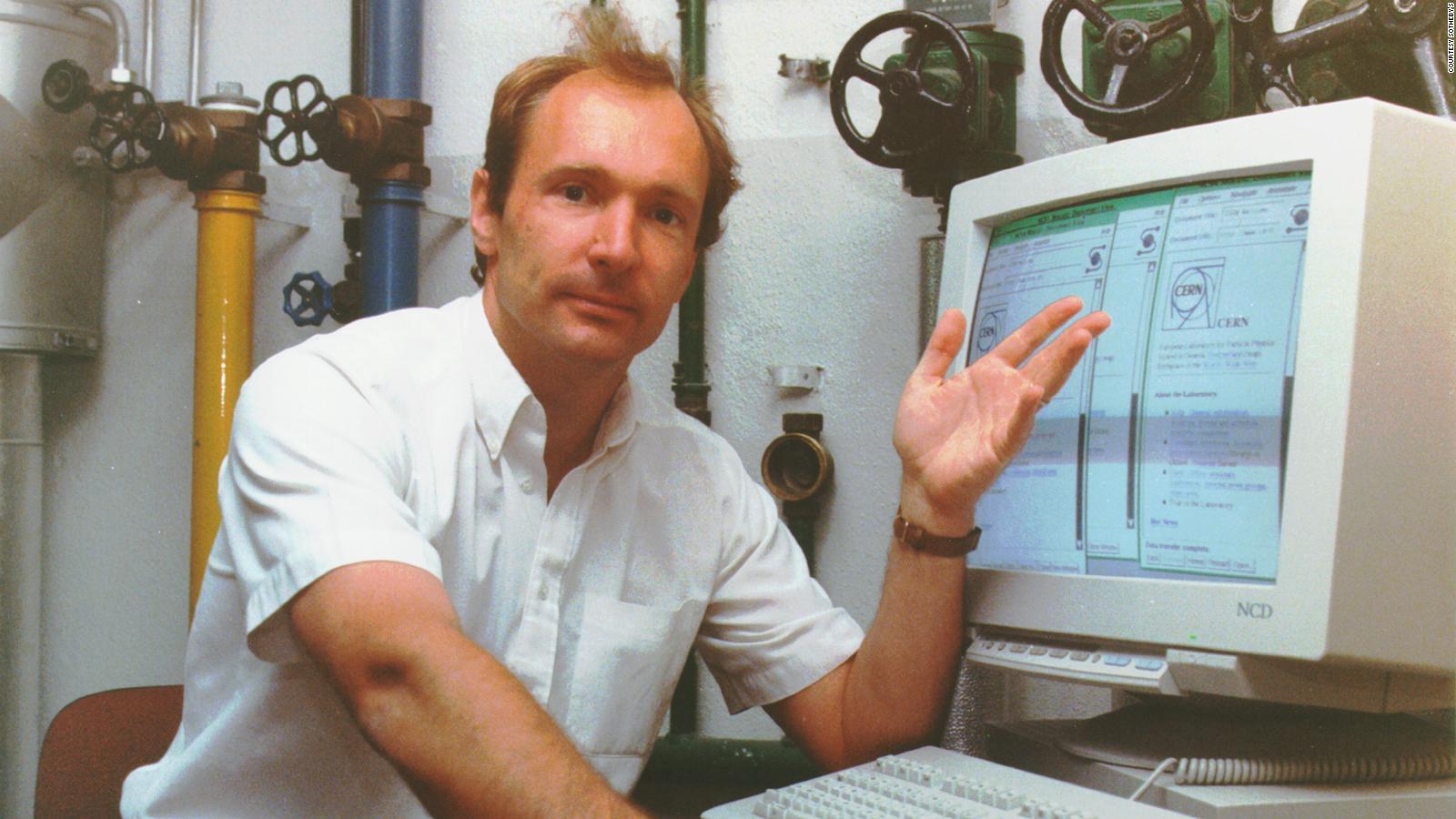
👆🏻 Sir Tim Berners- Lee
👶Web 1.0
In the 1990s, Web 1.0 was the fledgling version of the Internet. The web was viewed as a method to democratize access to knowledge, but there were few options for getting around it other than visiting a friend's GeoCities page. It was a jumbled mess that was difficult to navigate. It only had static HTML webpages (which meant that the content on the website couldn't change unless the website's code was manually modified and re-uploaded to the hosting service). The majority of these websites were for businesses advertising their products and services, as well as personal websites, informational websites.
Web 1.0 only offers single-way communication, the early web allowed us to search for information and read it. There was very little in the way of user interaction or content contribution.
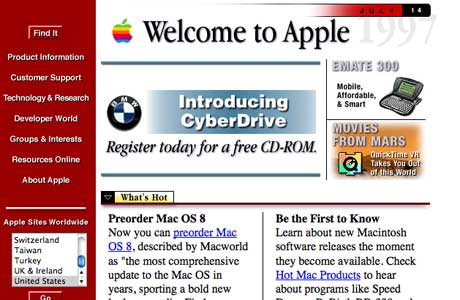 👆🏻 Apple at the time of web1.0
Features of a Web 1.0 site include:
- Static pages.
- Content is served from the server’s file system.
- Pages built using Server Side Includes or Common Gateway Interface (CGI).
- Frames and Tables are used to position and align the elements on a page.
- Directories.
- Mostly read-only.
- Banner advertising.
Limitations of Web 1.0
The major limitations of Web 1.0 are as follow:
- The webmaster is solely responsible for updating users and managing the content of website.
- Lack of Dynamic representation i.e., to acquire only static information, no web console was available to perform dynamic events.
- The Web 1.0 pages can only be understood by humans (web readers) do not have machine compatible content.
Web1.0 lasted roughly between 1989 to 2005
Web 1.0 was referred to as the first generation of World Wide Web which was basically defined as ” It is an information space in which the items of interest referred to as resources are identified by global an identifier called Uniform Resources Identifiers (URIs) “.
👦Web 2.0
The second generation of the internet is referred to as "Web 2.0." It was first described as a read-write web by Dale Dougherty in 2004. O'Reilly and Media Live International came up with the idea during a brainstorming session at a conference. Web 2.0 technologies enable massive worldwide populations with shared interests in social interactions to be assembled and managed.
Tim O’Reilly defines web 2.0 on his website as follows: “Web 2.0 is the business revolution in the computer industry caused by the move to the internet as a platform, and an attempt to understand the rules for success on that new platform. Chief among those rules is this: Build applications that harness network effects to get better the more people to use them.”
Web 2.0 enables formal and informal arenas of daily activities on the web by facilitating major qualities such as participatory, collaborative, and distributed behaviors. In other words, it shares many of the key features of Web 2.0, such as "relationship" technologies, participatory media, and social digital technology, which can also be referred to as the wisdom web.
The participatory web and the people-centric web are considered, and the ability to read and write on the web makes the web transaction bi-directional. Web 2.0 is a web platform where users can leave many of the controls they have used in web 2.0. In other words, the user of web 2.0 has more interaction with less control. Web 2.0 is not only a new version of web 1.0 but it also implies flexible web design, creative reuse, updates, collaborative content creation and modification in web 2.0 that should be considered as one of the outstanding features of web 2.0 is to support collaboration and to help gather collective intelligence rather Web 1.0.
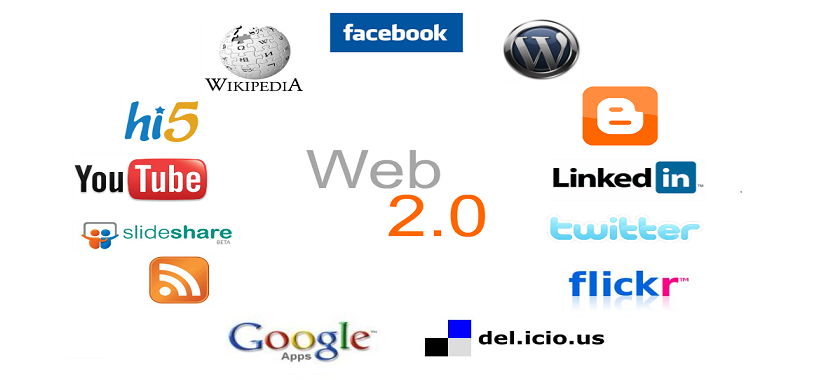
👆🏻 Examples of Web 2.0 websites
Features of a Web 2.0 site include:
Technology Centric Definition: The web has evolved into a platform with software that extends beyond a single device. Technology connected with blogs, wikis, podcasts, RSS feeds, and other similar sites.
Business Centric Definitions: A way of architecting software and businesses. The business revolution in the the computer industry was caused by the move to the internet as a platform and an attempt to understand the rules for success on that new platform.
User-Centric Definitions: The Social Web is often used to characterize sites that consist of communities. It is all about content management and new ways of communication and interaction between users. Web applications that facilitate collective knowledge production, social networking and increase user-to-user information exchange.
Limitations of Web 2.0
Constant iteration cycle of Change and Updates to services.
Ethical issues concerning the build and usage of Web 2.0.
Interconnectivity and knowledge sharing between platforms across communities, boundaries are still limited.
👨Web 3.0
An evolution. The goal is to create projects and applications that give people authority over their data and actions by replacing Web2's centralized monopolies with open protocols that require less trust because each activity can be validated using blockchain technology and encryption.
Why Do We Need Decentralization?
The Ethereum protocol's creator, Vitalik Buterin, authored an outstanding piece on the concept of decentralization.
Fault tolerance - Because they rely on a large number of separate components, decentralized systems are less likely to fail by mistake.
Attack resistance - Because they lack sensitive central locations that may be attacked at a far lower cost than the economic scale of the surrounding system, decentralized networks are more expensive to attack, destroy, or control.
Collusion resistance - It is much harder for participants in decentralized systems to collude to act in ways that benefit them at the expense of other participants, whereas the leaderships of corporations and governments collude in ways that benefit themselves but harmless well-coordinated citizens, customers, employees, and the general public all the time.
Three types of Decentralization
Decentralization isn't simply how many nodes a blockchain network has, or how many validators are online at a specific hour. Vitalik divides decentralization into three different forms.
Architectural decentralization — how many physical computers is a system made up of? How many of those computers can it handle failing at the same time?
Political decentralization — how many individuals or organizations ultimately control the computers that the system is made up of?
Logical decentralization — does the interface and data structures that the system presents and maintains look more like a single monolithic object, or an amorphous swarm? One simple heuristic is: if you cut the system in half, including both providers and users, will both halves continue to fully operate as independent units?
Characteristics of a Decentralized Application/System (Service)
Read + Write + Own.
Permission-less: The Service is available to anyone.
Open, transparent:The source code for the Service is available, and the user can inspect every aspect of it.
Censorship-resistant: No company, entity, or government can suppress your actions because they don't have control over the Service, hence can't exercise the control
Web3.0 also brought with it a slew of new words and concepts. Let's have a look at a few examples:
🧬Dapps
Short for Decentralized Apps. They're apps with backend code (mainly smart contracts built in the Solidity programming language) that runs on decentralized networks or blockchain technology. BitTorrent, PopCorn, and Tor are examples of apps that run on a peer-to-peer (P2P) or blockchain network.
KEY TAKEAWAYS
Decentralized applications—also known as "dApps" or "dapps"—are digital applications that run on a blockchain network of computers instead of relying on a single computer.
Because dApps are decentralized, they are free from the control and interference of a single authority.
Benefits of dApps include the safeguarding of user privacy, the lack of censorship, and the flexibility of development.
Drawbacks include the potential inability to scale, challenges in developing a user interface, and difficulties in making code modifications.
Ethereum dApps:
The Ethereum platform is used to power and construct these decentralized applications. Smart contracts are used to implement the logic in Ethereum dApps. They're built on the Ethereum network and save data on the platform's blockchain
🎨NFT in a Nutshell
NFT = Asset + Smart Contract.
A non-fungible token is a unique and non-interchangeable unit of data stored on a blockchain.
A non-fungible token can technically contain anything digital, including drawings, animated GIFs, songs, or items in video games. Non-fungible means it is individual. The opposite, fungible is an asset that can be swapped for another; they are identical (Dollar, Euro, ETH, or BTC).
NFTs can be owned and transacted by individuals as well as consignment to third-party brokers/wallets/auctioneers ("operators"). NFTs can represent ownership over digital or physical assets.
- Physical property — houses, unique artwork
- Virtual collectibles — unique pictures of kittens, collectible cards
- “Negative value” assets— loans, burdens, and other responsibilities
- In general, all houses are distinct, and no two kittens are alike. NFTs are distinguishable, and you must track the ownership of each one separately
In early March, a group of NFTs by digital artist Beeple was sold for over $69 million. The sale set a precedent and a record for the most expensive pieces of digital art sold thus far. The artwork was a collage comprised of Beeple's first 5,000 days of work.
Transaction Flow Diagram
The decentralized notions of Web3 architecture may appear confusing at first glance, as it necessitates a large number of independent components. In this article, I'll offer you a high-level view of how the components function together in the context of a real-world scenario: a customer purchasing an NFT.
Take a look at the diagram and then read the explanations below. If you memorize this diagram and can explain why each phase of the process is necessary by the end of the article, you will have a greater understanding of the Web3 ecosystem than 80% of developers.
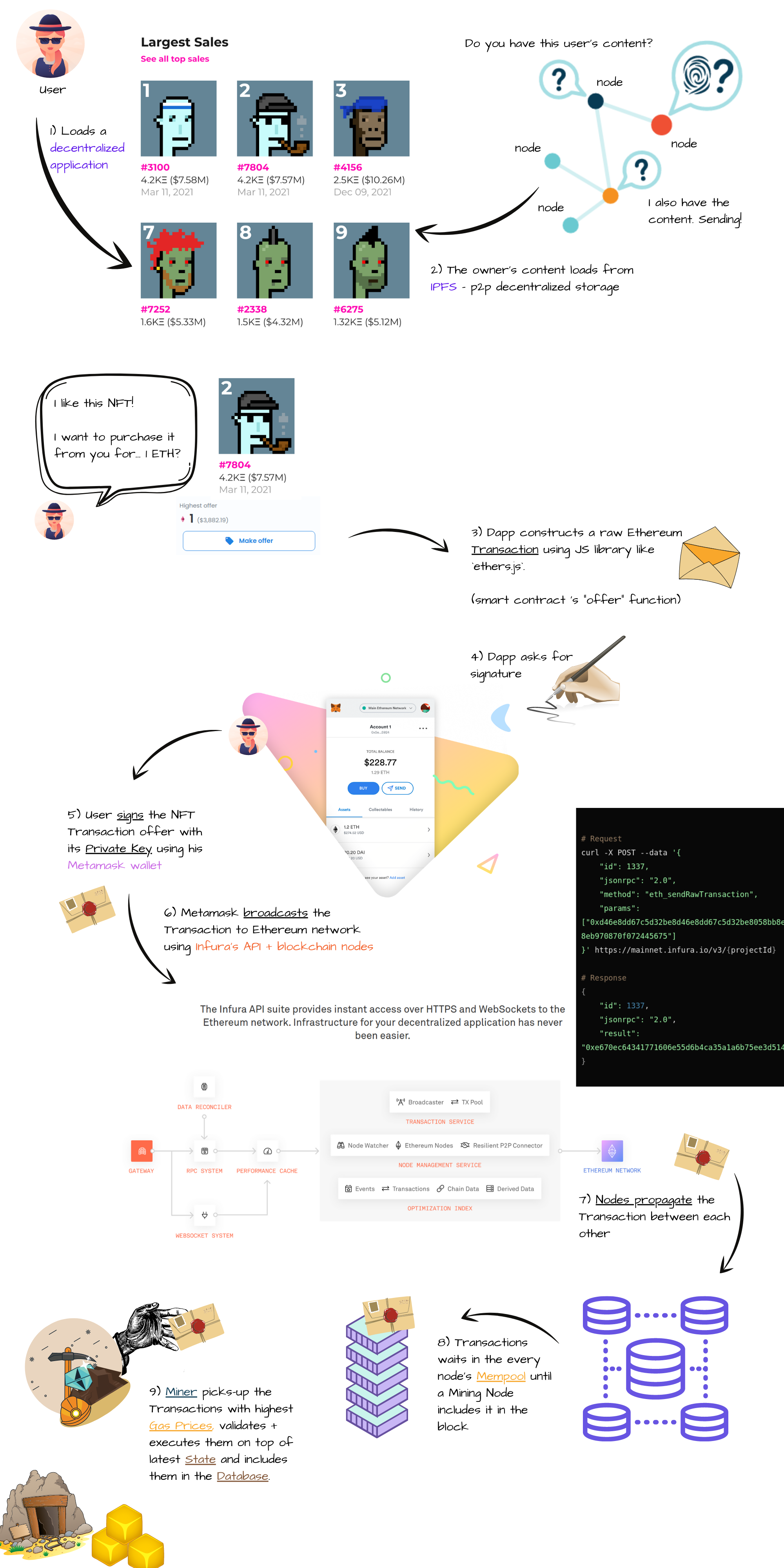
Credit: https://web3.coach/web3-architecture-cheatsheet
📜Smart Contract
A smart contract is a self-executing contract with the terms of the agreement between buyer and seller being directly written into lines of code. The code and the agreements contained therein exist across a distributed, decentralized blockchain network. The code controls the execution, and transactions are trackable and irreversible.
Smart contracts eliminate the requirement for a central authority, legal system, or external enforcement mechanism to carry out trustworthy transactions and agreements between distant, anonymous participants.
Nick Szabo, an American computer scientist who established a virtual currency dubbed "Bit Gold" in 1998, 10 years before the development of bitcoin, introduced smart contracts in 1994. In reality, Szabo is frequently mistaken for Satoshi Nakamoto, the anonymous creator of bitcoin, a claim he has refuted.
Szabo defined smart contracts as computerized transaction protocols that execute the terms of a contract. He wanted to extend the functionality of electronic transaction methods, such as POS (point of sale), to the digital realm.
WHAT YOU NEED TO KNOW
Smart contracts are self-executing contracts with the terms of the agreement between buyer and seller being directly written into lines of code.
Nick Szabo, an American computer scientist who invented a virtual currency called"Bit Gold" in 1998, defined smart contracts as computerized transaction protocols that execute the terms of a contract.
Smart contracts render transactions traceable, transparent, and irreversible.
🦊Metamask - Wallet Auth
You'll need an account to transact on Ethereum. There is no MySQL "users" table. There is no email/password login.
You'll need a crypto wallet like Metamask to create an Ethereum account. The wallet will be in charge of producing and securing your crypto keys, which will be used to sign transactions.
Metamask generates your Private Key. You derive the Public Key from the Private Key. Your account's address is the last 20 bytes of a hashed Public.
You are now ready to proceed after completing the registration process. This platform allows you to send and receive cryptocurrency.
🖥️Solidity
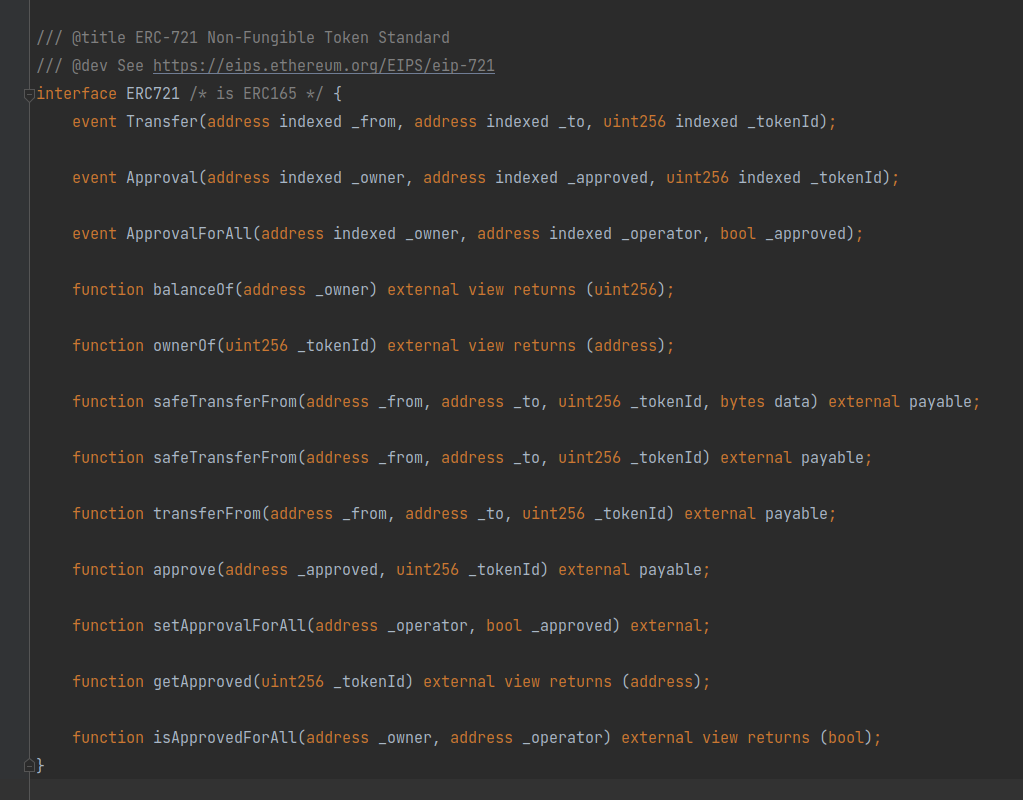
Solidity is an object-oriented programming language for writing smart contracts. It is used for implementing smart contracts on various blockchain platforms, most notably, Ethereum. Solidity's syntax is similar to javascript.
Credit: https://web3.coach/web3-architecture-cheatsheet
⛓️Blockchain
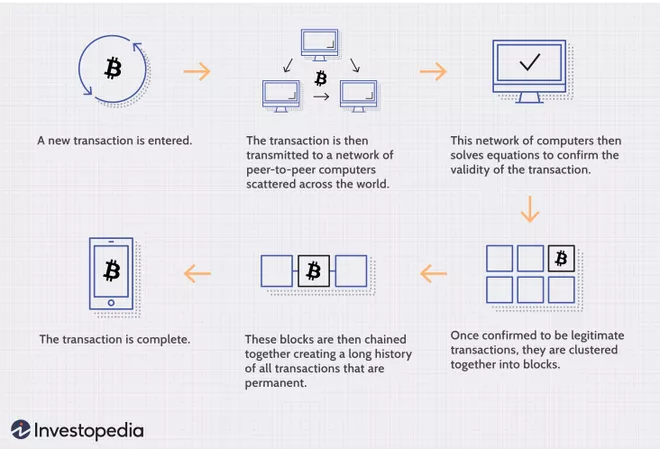
A blockchain is a distributed database that is shared among the nodes of a computer network. As a database, a blockchain stores information electronically in digital format. Blockchains are best known for their crucial role in cryptocurrency systems, such as Bitcoin, for maintaining a secure and decentralized record of transactions. The innovation with a blockchain is that it guarantees the fidelity and security of a record of data and generates trust without the need for a trusted third party.
The structure of the data on a blockchain differs from that of a traditional database. A blockchain organizes data into groupings called blocks, each of which contains a collection of data. Blocks have specific storage capabilities, and when they're full, they're closed and linked to the preceding block, producing a data chain known as the blockchain. All additional information added after that newly added block is compiled into a new block, which is then added to the chain after it is filled.
Blockchain is extremely safe and reliable.
On blockchain networks, users remain anonymous.
Blockchain aids in transaction verification and tracing.
The purpose of blockchain is to enable the recording and distribution of digital data without the ability to modify it. In this sense, a blockchain serves as the foundation for immutable ledgers, or transaction records that can't be changed, erased, or destroyed. Blockchains are also known as distributed ledger technology because of this (DLT).
The blockchain concept was first presented as a research project in 1991, and it before its first popular use in use, Bitcoin, in 2009. The creation of numerous cryptocurrencies, decentralized finance (Defi) applications, non-fungible tokens (NFTs), and smart contracts has skyrocketed the use of blockchains in the years thereafter.
How it works
Credit: Investopedia
💱DeFi
Decentralized finance (DeFi) is an emerging financial technology based on secure distributed ledgers similar to those used by cryptocurrencies. The system removes the control banks and institutions have on money, financial products, and financial services. You can use DeFi to perform any financial institution's services without the need for a third party.
Some of the key attractions of DeFi for many consumers are:
It does away with the fees that banks and other financial institutions levy for using their services.
Instead of depositing your money in a bank, you save it in a safe digital wallet.
It can be used by anyone with an internet connection without needing permission.
You can transfer money in a matter of seconds or minutes.
Two of DeFi's goals are to reduce transaction times and increase access to financial services.
💻DAO
Short for Decentralized Autonomous Organizations. It's an organization that uses blockchain technology to provide a secure digital ledger to track digital interactions across the internet. They are automated operations that function without the need for human involvement.
🪙Cryptocurrency
A cryptocurrency is a digital or virtual currency that is protected by encryption, making counterfeiting and double-spending practically impossible. Many cryptocurrencies are built on blockchain technology, which is a distributed ledger enforced by a distributed network of computers. Cryptocurrencies are distinguished by the fact that they are not issued by any central authority, making them potentially impervious to government intervention or manipulation. Examples of cryptocurrencies are:
- Bitcoin(BTC)
- Litecoin (LTC)
- Ethereum (ETH)
- Bitcoin Cash (BCH)
- Ethereum Classic (ETC)
- Zcash(ZEC)
- Stellar Lumen (XLM)
- Bitcoin Satoshi's Vision (BSV)
"I only see Web3 when I gaze into the future" -Richmond Ackon
🥇How will you benefit from Web3
The interesting thing is that everyone can profit from this technology, not only coders. "How is that?" you might wonder....🤔 Consider these benefits:
Ownership of Data or Information: End-users will recover entire ownership and control of their data while also benefiting from encryption security. Only with the owner's permission might information be shared.
Your privacy is protected.:One of the most significant benefits of blockchain and recent advances in cryptography is the ability to safeguard and trace your personal data on the Internet. You also remain anonymous because your name, email address, and other personal information are not requested or linked to you.
Unlimited access to information: No one can block you or deny you access to the service.
Working on the internet becomes much easier as the internet is personalized. : With web 3, you can work from wherever you want, whenever you want.
Fault tolerance: Web3's platforms are less likely to collapse due to their decentralized system architecture, which relies on numerous different components that are unlikely to fail. So, if you're running a Web3-based business, your platform will work without a hitch.
Final Words
To wrap off this article, here are some crucial items to remember regarding Web3. -It's built on blockchain technology, making it both safe and private. -It's decentralized (managed by more than one entity or organization). -It's transparent and open. -It's intelligent and AI-based. -Makes users remain anonymous and untrackable.
Next Steps in Your Web3 Journey - Continue Here
Your journey as a web3 developer has just become. In the subsequent articles, we will:
- How to become a web3 or Blockchain developer and deploy our Dapps onto the Blockchain
- How to develop our own smart contract using libraries such as ethers.js, solidity, etc
- How to make money from utilizing web3 technologies as a whole and many more
Conclusion:
Thank you for taking the time to read this. I hope you found this post to be informative. 🙏😀
If you have any questions Let's have a chat📣
Follow me on Twitter @richie_the_dev 🚶